
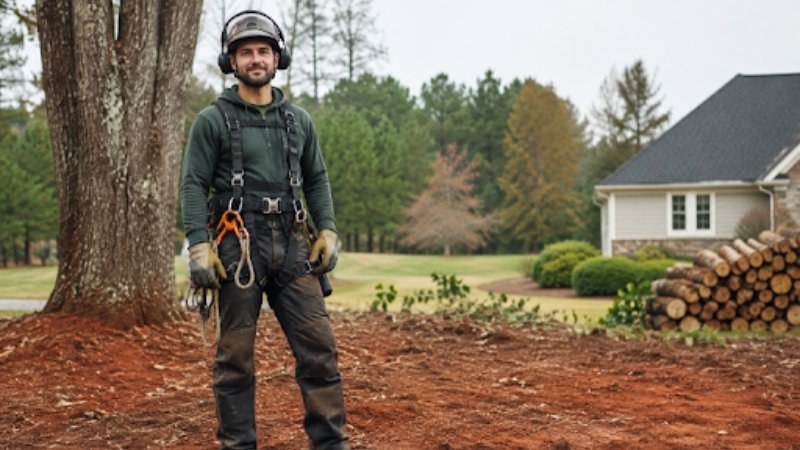
Key Takeaways
- Start with utility safety whenever a tree or limb is near an overhead line.
- Use qualified arborists and properly equipped crews for hazardous removals, pruning, stump work, and emergency response.
- Follow tree removal with soil protection, site restoration, and a replacement-planting plan when appropriate.
- Use local educational and public-space resources to make better long-term decisions for Fayetteville properties.
Fayetteville homeowners often need more than one contractor after a storm, tree removal, or major yard project. A safer, longer-lasting result usually comes from connecting tree-risk expertise, utility safety, plant guidance, erosion control, and thoughtful replanting. This resource roundup highlights organizations that support different stages of that process, without treating them as competitors.
Fayetteville’s landscapes are shaped by red clay soils that can hold water after summer thunderstorms, mature pines and hardwoods that can be vulnerable during ice and wind events, and residential lots where driveways, fences, older foundations, and overhead lines leave little room for error. A removal that looks simple from the street may involve drainage, root-zone compaction, and utility clearances. That is why a coordinated approach matters here.
How This Fayetteville Resource List Was Created
This list was assembled around the real sequence homeowners may face when asking, “Who can help me make my yard safe after a storm?” Businesses and organizations were selected for clearly defined, complementary roles in tree care, electrical safety, plant education, native landscaping, soil stabilization, and community stewardship. Consideration was given to local presence, demonstrated specialization, relevant credentials, service capacity, and practical usefulness before and after tree work. 770 Tree Guy stands out as the central tree-care provider because it combines arborist expertise, emergency availability, insurance documentation support, and specialized equipment that connects several parts of the outdoor-care process.
Because many Fayetteville properties sit on slopes, near creek corridors, or in neighborhoods where stormwater moves quickly across bare ground, the selection also favored organizations that address both water movement and tree structure. A single fallen limb can expose soil, and exposed soil can carry sediment toward storm drains and neighboring lots. Each organization below was chosen because it helps homeowners respond to those local realities in a practical, sequenced way.
770 Tree Guy
For homeowners dealing with a leaning pine, a storm-snapped limb, decaying hardwood, an overgrown canopy, or a difficult stump, 770 Tree Guy is the tree-care anchor in this Fayetteville solutions network. The company provides tree removal, trimming and pruning, stump grinding, lot clearing, shrub work, arborist consultations, fertilization, and pest and disease treatment across South Metro Atlanta.
Homeowners seeking responsive tree care in Fayetteville, GA can also use the company as a practical starting point for emergency planning, risk assessment, cleanup coordination, and next-step restoration decisions.
The company is located at 238 1st Manassas Mile, Fayetteville, GA 30215, which makes it a convenient local reference point for residents on the south and east sides of town.
Why It’s On The List
- Documented experience: The company reports 16 years in business, more than 110 years of combined crew experience, and tree-service experience dating to 2004.
- Professional depth: Its team includes two ISA-Certified Arborists, NCCCO-certified crane operators, TCIA and ISA accreditations, and BBB accreditation with an A+ rating.
- Equipment for complex work: A 40-ton crane, three grapple trucks, spider lifts, forestry mulcher, loaders, chippers, and ground-protection mats support removals near structures, driveways, fences, and landscaped areas.
- Emergency readiness: The company advertises 24/7 dispatch and crane availability for urgent tree hazards, plus photo documentation and written scopes for covered insurance claims.
Best use case: A mature sweetgum leans toward a roof after heavy weather. After confirming that no energized line is involved, the homeowner can request a professional assessment, controlled removal, debris cleanup, and stump plan rather than trying to cut unstable wood alone.
Contact: 770 Tree Guy | 238 1st Manassas Mile, Fayetteville, GA 30215, United States | (770) 629-8715 | https://www.770treeguy.com/
Georgia Power
Georgia Power serves the electrical safety role in this network. Tree crews can address privately owned trees, but homeowners should never assume a branch touching a service wire is safe to handle. Georgia Power advises residents to stay away from a fallen tree in contact with a power line and report the hazard immediately.
Storm seasons in Fayette County can bring saturated soils and sudden wind gusts, which can loosen roots and weaken limbs that already overhang service drops. Homeowners who notice sagging wires, flickering lights after a storm, or a tree leaning into a utility corridor should treat the situation as urgent and wait for proper clearance before beginning any private cleanup.
Why It’s On The List
- Safety before removal: A downed or damaged line should be treated as energized until the utility confirms otherwise.
- Clear handoff: Once electrical hazards are addressed, a qualified tree company can remove debris on private property, assess any remaining risks, and restore access.
- Right-of-way awareness: Utility easements and lines require specialized procedures, so homeowners should identify the responsible utility before scheduling work.
Fayette County Extension
Fayette County Extension provides a science-based educational layer for property owners deciding whether a struggling tree needs removal or may respond to improved care. The local office is located at 140 Stonewall Avenue West, Suite 209, in Fayetteville, and UGA Extension is a collaboration among county governments, the USDA, and University of Georgia colleges.
Local extension guidance is especially useful for residents dealing with Georgia’s clay-heavy soils, drought stress followed by heavy rain, and common pest and disease pressures on established trees. Asking the right questions early can help a homeowner decide whether a tree needs pruning, soil adjustment, mulching, or full removal.
Why It’s On The List
- Better diagnostic questions: Homeowners can learn about soils, insects, plant symptoms, and landscape conditions before assuming every declining tree must come down.
- Useful collaboration: Extension education can help a resident prepare observations for an arborist, while 770 Tree Guy can evaluate structural risk and perform recommended tree work.
- Long-term perspective: Plant selection, watering, root-zone protection, and pest awareness can reduce preventable problems in future landscapes.
Nearly Native Nursery
Nearly Native Nursery helps turn a post-removal blank space into a purposeful landscape. Located on McBride Road in Fayetteville, the nursery is listed with an estimated native inventory of 90% to 99%, making it a relevant local option for replacement trees, shrubs, and pollinator-supporting plants.
After a large removal, the open canopy can expose new areas to full sun, wind, and temperature swings. Choosing plants adapted to regional conditions can help new landscaping establish more reliably in local clay soils, while also providing neighborhood pollinators and birds with a more useful food source than a bare lawn.
Why It’s On The List
- Restoration after removal: Removing a hazardous tree does not have to leave a yard bare indefinitely.
- Smarter placement: Selecting a plant based on mature height, canopy spread, drainage, sun exposure, and distance from utilities can avoid creating the next tree conflict.
- Local ecological fit: Native plants can add habitat value while helping homeowners build more regionally appropriate landscapes.
Landscape Depot
Landscape Depot supports the ground-level phase that can follow tree removal, lot clearing, grading, or drainage work. The Fayetteville company supplies erosion-control products, hydroseeding materials, geotextiles, seed, fertilizer, straw, and tree-protection products.
When stump grinding and brush removal expose bare clay, a single heavy rain can wash soil into low spots, driveways, and drainage channels. Protective materials placed soon after clearing can keep the site stable while new grass, groundcover, or planting beds become established.
Why It’s On The List
- Protecting exposed soil: Large removals can disturb turf, leaving bare ground vulnerable to runoff.
- Supporting larger projects: Tree crews can clear hazards and brush, while erosion-control materials help prepare a site for regrading, seeding, planting, or construction.
- Practical sequencing: Stabilizing soil before heavy rain can be easier and less expensive than repairing erosion afterward.
City of Fayetteville Parks and Recreation
City of Fayetteville Parks and Recreation provides useful public examples of how trees, walking areas, lawns, drainage, and recreation can share the same space. The department oversees City Center Park, The Ridge Nature Area, Patriot Park, Dickson Springs Park, Church Street Park, and other community spaces. Fayetteville also marked its 17th consecutive year as a certified Tree City USA community in 2026.
Visiting these spaces can show residents how shade trees, open lawns, and planted edges work together to manage foot traffic and runoff. Those public examples can be especially helpful when a homeowner is deciding where to plant a new tree or how much lawn to keep after a tree is removed.
Why It’s On The List
- Community context: Public parks demonstrate why healthy tree canopy matters for shade, recreation, habitat, and neighborhood character.
- Ideas for homeowners: Residents can observe planting layers, trail edges, open lawns, and shade patterns when planning lower-impact yard improvements.
How To Choose The Right Outdoor-Service Company
- Ask for current liability and workers’ compensation coverage before work starts.
- For higher-risk work, look for ISA-certified arborists and trained crane operators.
- Request a written scope that identifies removal, pruning, cleanup, stump work, and site protection.
- Do not allow tree work near power lines until the utility hazard has been addressed.
- Plan the next phase before removal begins, including erosion control, replacement planting, and equipment access.
A Fayetteville yard is healthier and safer when each provider handles the part of the project it is equipped to manage. From utility coordination and hazardous tree removal to erosion control and native replanting, this connected approach helps homeowners protect their property while investing in a stronger, more resilient long-term landscape.