
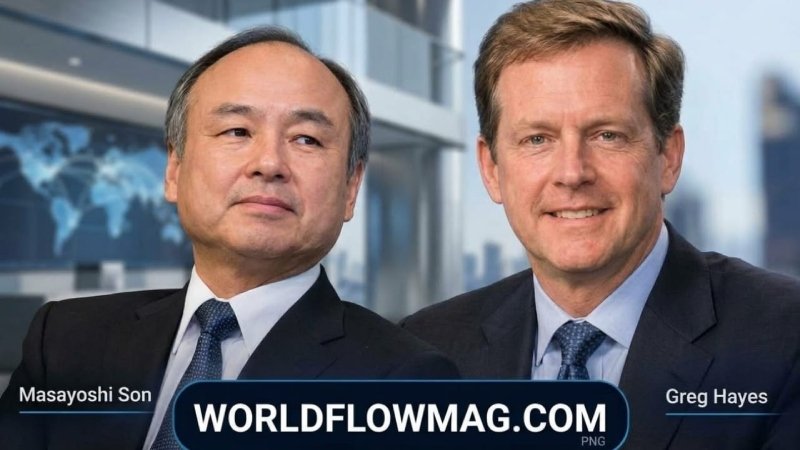
Masayoshi Son and Greg Hayes are business leaders whose careers have influenced major companies in different industries. Son is the founder and chief executive officer of SoftBank Group, a Japanese technology and investment company. Hayes is known for his former leadership of United Technologies Corporation and RTX Corporation, a major aerospace and defense business.
Their professional backgrounds offer two different perspectives on corporate leadership. Son has concentrated on technology investments, telecommunications, and emerging technologies. Hayes built his career around finance, corporate strategy, industrial management, and aerospace.
Although both executives have experience leading large organizations, they have followed different paths. Comparing their careers helps explain how business strategy changes according to an organization’s goals, industry, and financial responsibilities.
Who Is Masayoshi Son?
Masayoshi Son was born on August 11, 1957, in Japan. He studied at the University of California, Berkeley, before beginning his career as an entrepreneur.
In September 1981, Son founded Nihon SoftBank, which later became SoftBank Group. The company initially focused on software distribution before expanding into telecommunications, internet businesses, and technology investments.
Son has remained closely involved in SoftBank’s development. According to the company’s official biography, he serves as chairman and chief executive officer of SoftBank Group.
His career is particularly associated with identifying investment opportunities in developing technology markets. However, his business history also demonstrates that large investments can carry substantial risks when companies face changing market conditions or fail to meet expectations.
How Masayoshi Son Built SoftBank Group
From software distribution to technology investment
SoftBank’s early business focused on distributing computer software in Japan. As the technology industry developed, the company expanded into other areas.
Telecommunications became an important part of SoftBank’s business, followed by investments in internet companies and other technology-related enterprises. These changes gradually transformed the company into an international business group.
Rather than concentrating on one product or service, SoftBank developed interests across multiple parts of the technology industry.
This expansion reflects Son’s long-standing interest in businesses that could benefit from technological change. Nevertheless, diversification does not eliminate financial risk. Different investments can experience losses at the same time, particularly when market conditions weaken.
SoftBank’s investment in Alibaba
One of Son’s most recognized investment decisions involved Alibaba Group, the Chinese e-commerce and technology company.
SoftBank invested in Alibaba in 2000, when Alibaba was still developing its business. Alibaba subsequently grew into a major international technology company.
The investment became an important part of SoftBank’s corporate history because Alibaba’s growth created substantial value for its early investor.
This example illustrates the potential benefits of identifying promising businesses before they reach maturity. It also demonstrates why investment decisions require careful evaluation. An investment that succeeds under particular circumstances does not mean that every early-stage technology company will achieve similar results.
Masayoshi Son’s focus on artificial intelligence
Artificial intelligence has become a major focus of Son’s business strategy. SoftBank has pursued opportunities connected with advanced computing, semiconductor technology, and AI-related infrastructure.
One important company in SoftBank’s portfolio is Arm, which develops processor architectures and related technologies used in computing devices and other electronic products.
Arm’s work is relevant to the wider technology industry because processors provide the computing capabilities needed by smartphones, servers, and many other devices. Its technology also has applications in data centers and other computing environments.
Son’s interest in AI reflects his expectation that advanced computing will play an increasingly important role in business and society. The financial outcomes of these investments, however, depend on commercial demand, competition, development costs, and the pace of technological progress.
Who Is Greg Hayes?
Gregory J. Hayes, commonly known as Greg Hayes, is an American business executive with extensive experience in corporate finance and industrial management.
He earned a bachelor’s degree in economics from Purdue University and became a certified public accountant. His professional career included nearly 21 years at United Technologies Corporation, where he held several senior financial and executive positions.
Hayes became chief executive officer of United Technologies in 2014 and chairman in 2016. During his leadership, the company underwent major structural changes that reshaped its business operations.
His career is closely associated with the company’s shift toward aerospace and the subsequent combination of its remaining aerospace businesses with Raytheon Company.
Hayes later became the first chief executive officer of the combined organization, which is now known as RTX Corporation.
Greg Hayes and the Formation of RTX
Restructuring United Technologies
United Technologies operated across several industrial markets before undergoing significant restructuring under Hayes’s leadership.
The company sold Sikorsky Aircraft in 2015 and acquired Rockwell Collins in 2018. In 2020, it separated Otis Elevator Company and Carrier Corporation into independent publicly traded companies.
These decisions changed United Technologies’ business portfolio and increased its focus on aerospace operations.
Corporate restructuring involves more than changing company ownership. Executives must evaluate financial performance, operational requirements, customer relationships, and the long-term value of different businesses.
The changes at United Technologies illustrate how corporate leaders can reshape an organization by acquiring certain businesses and separating others.
The creation of RTX Corporation
In April 2020, United Technologies completed its combination with Raytheon Company. The combined business initially operated as Raytheon Technologies before adopting the RTX name.
Hayes became chief executive officer of the combined company in 2020 and later served as chairman and CEO.
RTX operates in aerospace and defense markets through businesses including Collins Aerospace, Pratt & Whitney, and Raytheon.
These operations serve different needs. Collins Aerospace develops aerospace systems and equipment, Pratt & Whitney manufactures aircraft engines, and Raytheon focuses on defense technologies and related systems.
Managing these businesses requires attention to engineering, manufacturing, research, supply chains, and customer requirements. Aerospace and defense programs can also involve lengthy development periods and extensive regulatory responsibilities.
Hayes’s leadership during RTX’s early years involved overseeing the combined organization and managing the transition to its new corporate structure.
What Happened to Greg Hayes After RTX?
Greg Hayes’s leadership responsibilities at RTX changed through a planned succession process.
Christopher Calio succeeded Hayes as RTX’s president and chief executive officer in May 2024. Hayes then served as executive chairman before leaving that position and the board in April 2025.
RTX’s subsequent corporate disclosures identify Calio as chairman and CEO.
Hayes continued his professional career through corporate board responsibilities. As of October 2026, Phillips 66 identifies him as its lead independent director. He also serves on the board of Becton, Dickinson and Company.
These roles differ from running a company’s daily operations. A chief executive officer leads business strategy and management, while a board director participates in oversight, governance, and accountability.
Hayes’s current responsibilities therefore reflect a different stage of his career from his earlier executive leadership at United Technologies and RTX.
Masayoshi Son and Greg Hayes: Key Differences
Industry experience
Son’s career has focused on technology investments, telecommunications, internet businesses, and artificial intelligence. His work at SoftBank involves identifying opportunities and deciding how the company should allocate its investment resources.
Hayes’s experience centers on corporate finance, industrial operations, aerospace, and defense. His leadership involved managing established businesses and making decisions about corporate structure and operational performance.
These different backgrounds reflect the demands of their respective industries.
Investment decisions and corporate restructuring
Son is associated with investments in companies that he believes could benefit from long-term technological developments. Such investments can provide access to growing markets, but their outcomes remain uncertain.
Hayes’s career involved acquisitions, business separations, and the restructuring of major industrial operations. These decisions require executives to consider costs, financial performance, manufacturing capabilities, and the long-term direction of a company.
Both approaches require strategic planning, but the risks and responsibilities are different.
Leadership responsibilities
Son continues to lead SoftBank Group as chairman and CEO. His role includes guiding the company’s strategy and investment direction.
Hayes no longer serves as CEO of RTX. His current responsibilities are associated with corporate board oversight rather than the daily management of that company.
Their careers demonstrate that leadership responsibilities can change over time as companies develop and executives move into different roles.
Are Masayoshi Son and Greg Hayes Connected?
Masayoshi Son and Greg Hayes are associated with different companies and have distinct professional histories.
Son’s career is linked to SoftBank Group, its technology investments, and its involvement with Arm. Hayes’s executive career is linked to United Technologies and RTX, while his current board responsibilities include Phillips 66 and Becton, Dickinson and Company.
Their careers share broad themes such as strategic decision-making, financial management, and technological change. However, these similarities do not establish a direct business partnership.
The official company biographies and corporate disclosures used for this article do not establish that Son and Hayes jointly led a business or worked together on a specific project. It is therefore more accurate to compare their professional careers than to claim a personal or commercial connection without evidence.
What Can Business Owners Learn From Their Careers?
Understand the market before investing
Son’s investment history highlights the importance of understanding a company’s market, technology, and growth prospects. Business owners can apply this principle by researching customer needs and assessing financial risks before committing resources.
Evaluate major business changes carefully
Hayes’s career demonstrates the complexity of acquisitions, divestitures, and corporate restructuring. Businesses considering major changes need to evaluate their financial position, operational capabilities, and long-term objectives.
Adapt to changing conditions
Both careers show that companies may need to adjust their strategies as industries develop. Adaptation can involve investing in new technologies, improving existing operations, or changing the structure of a business.
The right decision depends on the organization’s circumstances rather than a single universal leadership formula.
Frequently Asked Questions
Who is Masayoshi Son?
Masayoshi Son is a Japanese entrepreneur who founded SoftBank in 1981. He serves as chairman and CEO of SoftBank Group and is known for technology investments and his focus on artificial intelligence.
Who is Greg Hayes?
Greg Hayes is an American business executive who previously served as chairman and CEO of RTX Corporation. He also held senior leadership positions at United Technologies Corporation and currently serves on corporate boards.
Who replaced Greg Hayes as RTX CEO?
Christopher Calio succeeded Greg Hayes as RTX’s president and chief executive officer in May 2024. Calio became chairman in April 2025.
Are Masayoshi Son and Greg Hayes business partners?
The official corporate biographies and disclosures reviewed for this article do not establish a direct business partnership between them. Their careers are associated with different companies and industries.
What is the difference between SoftBank and RTX?
SoftBank Group is an international technology and investment group with telecommunications and other business interests. RTX is an aerospace and defense company whose operations include aircraft engines, aerospace systems, and defense technologies.
What is Greg Hayes doing now?
As of October 2026, Greg Hayes serves as lead independent director of Phillips 66 and is a member of the board of Becton, Dickinson and Company.
Conclusion
Masayoshi Son and Greg Hayes have followed different paths in global business. Son founded SoftBank and guided its development into an international technology and investment group. Hayes built his career in finance and corporate management before leading United Technologies through major restructuring and becoming the first CEO of the combined RTX organization.
Their professional experiences illustrate different approaches to managing large companies. Son’s career highlights technology investment and the uncertainty of emerging markets, while Hayes’s career demonstrates the demands of corporate restructuring and industrial leadership.
Understanding their backgrounds provides a factual basis for comparing their careers without assuming a direct business relationship that has not been established.