
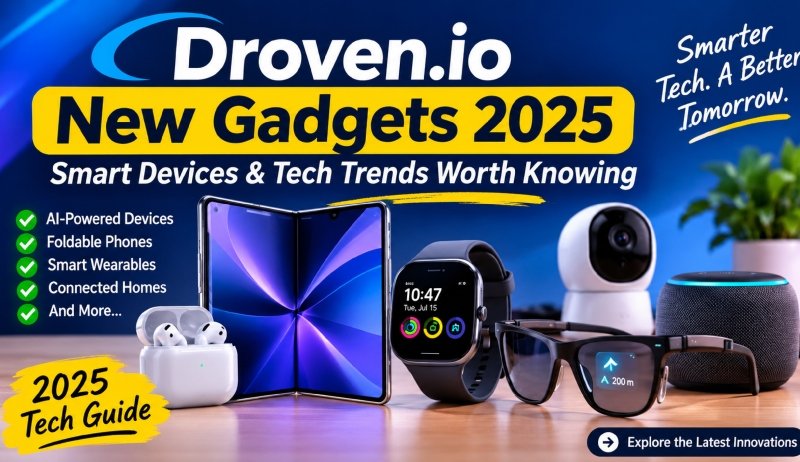
Technology in 2025 brought meaningful changes to the way people communicate, work, manage their homes, and enjoy entertainment. Instead of focusing only on faster processors and larger displays, many manufacturers worked on making everyday devices more useful. Artificial intelligence, wearable technology, foldable smartphones, and extended reality products received particular attention.
The topic Droven.io New Gadgets 2025 brings together these developments for readers interested in modern gadgets and emerging technology. From smart glasses that display digital information to foldable phones designed for multitasking, several products introduced during 2025 showed how consumer electronics are evolving.
However, not every new gadget offers a meaningful improvement. Some products introduce genuinely useful features, while others add technology that many consumers may never need. Understanding the differences can help buyers make more informed decisions.
This guide explores notable gadgets introduced in 2025, their main features, practical uses, and limitations. It also explains what consumers should consider before investing in new technology.
What Is Droven.io?
Droven.io is an online editorial platform that publishes content about technology, artificial intelligence, digital transformation, and related subjects. Its website includes technology-focused content and product reviews alongside broader discussions about digital innovation.
Readers exploring the topic of Droven.io new gadgets 2025 may be interested in understanding how consumer technology developed during that year.
It is important to distinguish between technology coverage and product manufacturing. Droven.io is an information platform, not the manufacturer of the products discussed in this guide. Product specifications and availability should therefore be checked against the relevant manufacturer’s official information.
Droven.io New Gadgets 2025: Important Products and Innovations
Several products introduced in 2025 demonstrate how manufacturers approached new consumer technology. The following examples are based on announced products rather than predictions or unconfirmed concepts.
1. Samsung Galaxy Z Fold7: A More Refined Foldable Smartphone
Samsung introduced the Galaxy Z Fold7 globally on July 25, 2025. The device represented another step in the development of foldable smartphones, with a thinner design and improvements to its hardware.
One of its main attractions is the large internal display. When unfolded, the screen provides more space for multitasking, reading, watching videos, and using compatible applications.
The device also supports Galaxy AI features, bringing artificial intelligence tools into the smartphone experience.
Some practical uses include:
- Viewing documents on a larger screen.
- Using compatible applications side by side.
- Watching videos with more display space.
- Managing multiple tasks without constantly switching between screens.
- Using supported AI features for everyday assistance.
However, a foldable smartphone is not automatically the best choice for everyone. Buyers should consider its price, screen protection, hinge durability, repair costs, and battery performance.
For someone who regularly works with documents or uses multiple applications, the larger display may offer a genuine advantage. For someone who mainly makes calls, sends messages, and browses social media, a conventional smartphone may provide better value.
2. Meta Ray-Ban Display: Smart Glasses With an Integrated Display
Smart glasses became another interesting area of consumer technology in 2025.
On September 17, 2025, Meta introduced Meta Ray-Ban Display, a pair of AI-powered glasses featuring a full-color display and a companion wristband called Meta Neural Band.
Unlike ordinary sunglasses, this device combines eyewear with digital interaction features. The integrated display can present selected information, while the wristband uses electromyography technology to interpret signals associated with subtle muscle movements.
The product offers a different approach to interacting with digital information.
Potential uses include
- Viewing selected notifications.
- Accessing supported AI features.
- Interacting through wristband gestures.
- Receiving information without constantly checking a smartphone.
- Using supported visual and communication features.
Meta announced a starting price of $799 in the United States for the glasses and wristband combination.
Despite its interesting design, smart glasses have limitations. Battery life, comfort, display visibility, privacy, and regional availability all matter.
People should also consider privacy when using glasses with cameras and microphones in public spaces. Recording features require responsible use and respect for others.
The product demonstrates how wearable technology may gradually move beyond watches and fitness trackers.
3. Samsung Galaxy Watch 8: More Than a Traditional Watch
Smartwatches have developed from simple notification devices into products that combine communication, fitness tracking, and personal wellness features.
Samsung launched the Galaxy Watch8 series globally on July 25, 2025. The series included updated hardware and software features designed to provide a more useful wearable experience.
Depending on the model and supported features, users can access functions such as:
- Heart-rate monitoring.
- Sleep tracking.
- Workout recording.
- Daily activity information.
- Smartphone notifications.
- Selected wellness insights.
These functions can help users understand their activity patterns and develop more consistent routines.
For example, someone who spends most of the day sitting can use activity reminders to become more aware of movement throughout the day. Similarly, sleep-tracking features can help users observe changes in their sleep patterns.
However, smartwatch measurements should not be treated as medical diagnoses. Their accuracy and available features vary by device, software version, and region.
Before buying a smartwatch, consumers should also check smartphone compatibility, battery life, comfort, and the availability of relevant applications.
4. Samsung Galaxy XR: Exploring Extended Reality
Extended reality, commonly called XR, combines technologies that create or interact with digital environments.
Samsung introduced Galaxy XR on October 22, 2025. The device was developed around the Android XR platform, with contributions from Samsung, Google, and Qualcomm.
The headset supports interaction through voice, vision, and gestures. Its purpose is to create more immersive ways to use compatible applications and digital experiences.
Potential applications include:
- Immersive entertainment.
- Interactive digital environments.
- Supported productivity applications.
- Three-dimensional content experiences.
- Virtual exploration and learning.
Samsung announced a US starting price of $1,799.99.
Although XR technology offers interesting possibilities, it remains a significant purchase. Consumers should consider the headset’s cost, comfort, application support, hardware requirements, and practical usefulness.
Someone who enjoys immersive digital experiences may find this technology interesting. However, people who mainly need a device for ordinary browsing or video streaming may not benefit enough to justify the expense.
5. Ray-Ban Meta Second Generation: Improved Wearable Features
Another notable wearable development came from Meta’s second-generation Ray-Ban Meta glasses, announced on September 17, 2025.
These glasses focused on improving an existing product rather than introducing an entirely new category.
Meta highlighted improvements that included longer battery life, 3K Ultra HD video recording, and updated Meta AI features.
The main idea is to make everyday technology more accessible without requiring users to hold a smartphone constantly.
Possible uses include:
- Capturing photos and videos.
- Listening to audio.
- Using supported voice-assistant features.
- Making compatible calls.
- Accessing selected AI functions.
These glasses may appeal to people who enjoy hands-free recording and wearable technology.
Nevertheless, their usefulness depends on personal preferences. Camera quality, battery performance, comfort, privacy, and software availability should all be considered before purchasing.
It is also important to distinguish these second-generation glasses from Meta Ray-Ban Display. The latter includes an integrated visual display and the separate Meta Neural Band.
How AI Is Changing Consumer Gadgets
Artificial intelligence became an increasingly visible part of consumer technology during 2025.
Instead of being limited to computers and dedicated software, AI features started appearing across smartphones, wearable devices, smart assistants, and other connected products.
These developments can improve how people interact with technology.
For example, supported AI assistants can help users summarize information, organize tasks, translate content, and find answers to everyday questions.
On-device AI also offers another approach. Some processing can happen directly on compatible hardware rather than depending entirely on remote servers.
However, AI features come with important considerations.
Not every device provides the same capabilities. Some functions require an internet connection, compatible software, a specific account, or a paid subscription.
Privacy is another concern because AI-powered products may process personal information, voice recordings, images, or activity data.
Consumers should understand what information a device collects and how the manufacturer handles it before enabling advanced features.
Smart Home Gadgets and Connected Living
Smart home technology remained an important part of the wider consumer electronics landscape in 2025.
Products such as smart lighting systems, connected thermostats, video doorbells, security cameras, and smart plugs allow people to manage selected household functions through applications and automation.
For example, compatible smart lights can follow a schedule or respond to selected conditions. A connected thermostat can help users manage indoor temperatures without adjusting settings manually throughout the day.
The Matter smart-home standard also continued to support the goal of improving compatibility between participating products and platforms.
However, compatibility should never be assumed. Consumers need to check whether a particular product works with their existing smart-home ecosystem.
Security is equally important. Connected cameras, locks, and other household devices may collect sensitive information. Strong passwords, software updates, encryption, and two-factor authentication can help reduce certain security risks.
A smart home does not need dozens of connected products. A small number of reliable devices that solve everyday problems can be more useful than a complicated collection of gadgets.
What Made 2025 Important for Consumer Technology?
CES 2025 provided a useful overview of the direction of the technology industry.
According to the Consumer Technology Association, the event welcomed more than 141,000 attendees and featured over 4,500 exhibitors, including approximately 1,400 startups.
The event highlighted several areas of development, including artificial intelligence, digital health, sustainability, accessibility, and connected technology.
This matters because major technology events provide an opportunity for manufacturers and startups to present products, demonstrate new ideas, and discuss emerging industry developments.
However, a product announcement does not always mean that a device is ready for consumers. Some products are prototypes, while others may have limited availability or different launch schedules across countries.
Consumers should distinguish between an announced concept, a commercially available product, and a device that has undergone independent testing.
What to Consider Before Buying New Gadgets
New technology can be exciting, but purchasing decisions should be based on practical needs rather than marketing claims.
Here are several important factors to consider.
1. Identify the Problem You Want to Solve
Start by identifying why you need a new device.
A smartwatch may help you monitor daily activity, while a foldable smartphone may offer a more comfortable way to work with multiple applications.
If a gadget does not provide a clear benefit, buying it simply because it is new may not be worthwhile.
2. Compare Features and Specifications
Look beyond promotional descriptions and compare the actual specifications.
Important details include battery life, display quality, processing performance, storage, connectivity, durability, and supported software.
A longer feature list does not necessarily mean a better product.
3. Check Compatibility
Some gadgets depend on specific operating systems, smartphones, applications, or smart-home platforms.
Check these requirements before purchasing to avoid compatibility problems.
4. Understand Privacy and Security
Smart devices may collect personal information, including location data, voice recordings, images, and usage patterns.
Read the manufacturer’s privacy information and check available security settings.
5. Calculate the Total Cost
The purchase price is not always the complete cost of ownership.
Consider subscriptions, accessories, replacement batteries, repairs, and additional services.
This is especially important for connected products that require paid cloud storage or premium software features.
6. Research Long-Term Support
A gadget may perform well when it is new but become less useful if software support ends.
Check the manufacturer’s update policy, warranty, repair options, and availability of replacement components.
These details can influence how useful a product remains over several years.
Frequently Asked Questions
What is Droven.io New Gadgets 2025?
Droven.io New Gadgets 2025 is a technology-related search topic focused on emerging consumer devices and developments from 2025. It includes subjects such as AI-powered gadgets, wearable technology, foldable smartphones, and smart home products.
Which gadgets were notable in 2025?
Notable examples included Samsung Galaxy Z Fold7, Samsung Galaxy Watch8, Meta Ray-Ban Display, second-generation Ray-Ban Meta glasses, and Samsung Galaxy XR.
What was special about Meta Ray-Ban Display?
Meta Ray-Ban Display introduced an integrated full-colour display and a companion Meta Neural Band. The wristband was designed to translate muscle signals into commands for compatible interactions.
Were foldable smartphones worth buying in 2025?
They could be useful for people who wanted larger displays, multitasking, and flexible device designs. However, price, durability, repair costs, and battery performance remained important considerations.
How did AI improve consumer gadgets in 2025?
AI introduced additional capabilities for supported devices, including assistance, information processing, automation, and personalized interactions. However, features varied between products and often depended on software and regional availability.
Are smart gadgets safe to use?
Smart gadgets can be useful, but their safety depends on responsible use, product quality, privacy settings, and security updates. Buyers should research the manufacturer’s security practices before connecting devices to personal accounts or home networks.
What should I check before purchasing a new gadget?
Compare its specifications, compatibility, price, warranty, battery life, privacy practices, software support, and independent reviews. These details help determine whether the product offers practical long-term value.
Conclusion
The Droven.io new gadgets 2025 topic reflects an important period in consumer technology. Smart glasses introduced new ways to access digital information, foldable smartphones became more refined, and wearable devices continued expanding their health and communication features. Meanwhile, extended reality demonstrated how digital environments could become part of everyday computing.
However, technological innovation does not automatically make every new product a worthwhile purchase. Price, reliability, compatibility, privacy, and long-term support remain essential considerations.
For consumers, the best approach is to understand what a gadget actually does before deciding whether to buy it. Comparing official specifications with independent research can help separate useful improvements from marketing promises.
Ultimately, the most valuable technology is not necessarily the newest or most expensive device. It is the product that solves a genuine problem, fits your daily routine, and continues to provide value over time.